 Concrete Calculator
Stair Calculator UK - Concrete Stairs & Steps
Instantly calculate the exact volume, bags, and cost for your project.
Professional Stair Calculator
Calculate concrete for stairs, outdoor steps, garden stairways & patio stairs. Accurate calculations for stairs steps, risers, and treads with instant volume and cost estimates.
Calculation Results
Total Volume
0 m³
Estimated Weight
0 kg
Estimated Cost
£0
@ £/m³
Coverage Area
-
Pro Tip: Always order 5-10% extra concrete to account for spillage, uneven surfaces, and depth variations.
How to Calculate Concrete for Stairs

Concrete stairs are irregular shapes, so you cannot just multiply length by width by depth. Break the staircase into individual steps and a base slab, then add the volumes together.
Each step is a rectangular block. Multiply the width of the staircase by the step rise (height) by the step going (tread depth). For a typical set of 5 garden steps at 900mm wide, 175mm rise, and 275mm going: each step = 0.9 × 0.175 × 0.275 = 0.043m³. Five steps = 0.216m³.
Add the base slab underneath. If the base is 900mm wide, 1,375mm long (5 treads × 275mm), and 100mm thick, that is 0.9 × 1.375 × 0.1 = 0.124m³. Total volume: 0.216 + 0.124 = 0.34m³. With 10% waste, order 0.37m³, which is about 31 bags of 25kg premix.
The concrete stairs calculator above does this maths for you. Enter step count, rise, going, and width to get an instant volume and bag count.
UK Standard Stair Dimensions

Building Regulations Approved Document K sets the rules for stairs in England and Wales. The key numbers: maximum rise of 220mm, minimum going of 220mm, and the pitch must not exceed 42 degrees. For private dwellings, a rise between 150mm and 220mm with a going between 220mm and 300mm keeps you compliant.
Most builders aim for a rise of 175mm and a going of 250-275mm. That gives a comfortable walking angle around 34 degrees. Here are common configurations:
| Total Height | Rise per Step | Going | Number of Steps | Pitch |
|---|---|---|---|---|
| 525mm | 175mm | 275mm | 3 | 32° |
| 700mm | 175mm | 275mm | 4 | 32° |
| 875mm | 175mm | 275mm | 5 | 32° |
| 1,050mm | 175mm | 250mm | 6 | 35° |
| 1,400mm | 200mm | 250mm | 7 | 39° |
Outdoor steps can be less steep than indoor stairs. A rise of 150mm with a going of 300mm feels generous and handles rain better. If the steps connect to a public path, check with your local council for additional requirements.
Common Outdoor Stair Projects
Garden steps, patio steps, and front door steps account for most DIY concrete stair projects in the UK. Each has different sizing and concrete needs. Here is a quick reference using 25kg bags with 10% waste:
| Project | Steps | Width | Rise × Going | Volume (m³) | 25kg Bags |
|---|---|---|---|---|---|
| Front door steps | 2 | 1,200mm | 175 × 275mm | 0.15 | 14 |
| Patio to garden | 3 | 900mm | 175 × 275mm | 0.18 | 17 |
| Garden slope | 5 | 900mm | 175 × 275mm | 0.37 | 31 |
| Decking to lawn | 3 | 1,500mm | 150 × 300mm | 0.28 | 24 |
| Side passage | 4 | 750mm | 175 × 250mm | 0.19 | 16 |
Use the stair calculator at the top of this page with your exact measurements. These figures assume a 100mm base slab under the steps. Wider front door steps or curved garden steps need more concrete, so measure carefully.
Tips for Building Concrete Stairs
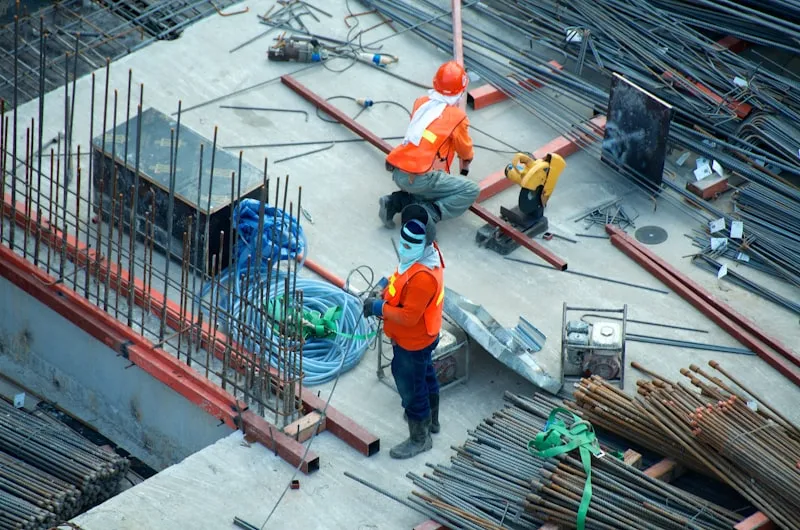
Build your formwork from 18mm plywood or scaffold boards. Cut side panels to the full stair profile and brace them every 300mm with pegs or stakes driven into the ground. Concrete is heavy: 2,400kg per cubic metre when wet. Weak formwork bulges, and your steps end up wonky.
For steps up to 600mm total height, 6mm A142 mesh reinforcement laid on spacers is enough. Taller staircases or those carrying vehicle loads need 10mm rebar at 200mm centres. Ask your local builders merchant for advice if you are unsure.
Pour from the bottom step upward. Fill each step, tamp it down with a timber straight edge, then move to the next. Working upward stops wet concrete from slumping down and ruining the step below. Finish the top step last.
Wait at least 24 hours before removing formwork, and keep the concrete damp for 3-5 days by covering it with polythene or damp hessian. Rushing this stage causes surface cracks. If you need to calculate concrete for the landing slab at the top, try our slab calculator. For steps with deep foundations, our footing calculator helps size the base.