 Concrete Calculator
Concrete Block Calculator UK — Blocks, Mortar & Cost
Work out how many concrete blocks you need for any wall. Enter length and height, choose your block thickness, and get a block count, mortar volume, sand and cement quantities, and a total cost estimate.
Concrete Block Calculator
Choose a project type for standard UK wall sizes, or enter custom dimensions. Results include block count, mortar, and material breakdown.
Results
Wall Area
10.80 m²
after deductions
Blocks Needed
114
incl. waste
Courses
8
at 225mm per course
Estimated Cost
£205.20
blocks only
Mortar Breakdown (1:5 cement:sand mix)
Quantities for 10mm bed and perpend joints at your chosen block thickness.
Mortar Volume
0.130 m³
Cement
39 kg
2 × 25kg bags
Sand
194 kg
Tip: For walls over 1.2m, add piers at every 3m and at corners. Piers use extra blocks not included in this estimate.
How to Use the Concrete Block Calculator
Choose your wall type
Select Garden Wall, Garage Wall, or Retaining Wall. Standard UK dimensions fill in automatically.
Set dimensions and thickness
Adjust length and height. Pick block thickness: 100mm, 140mm, or 215mm. Use the dropdown to switch units. Your preference from Settings loads automatically.
Read your results
See block count, courses, mortar volume, cement and sand quantities, and total cost.
How to Calculate Concrete Blocks for a Wall
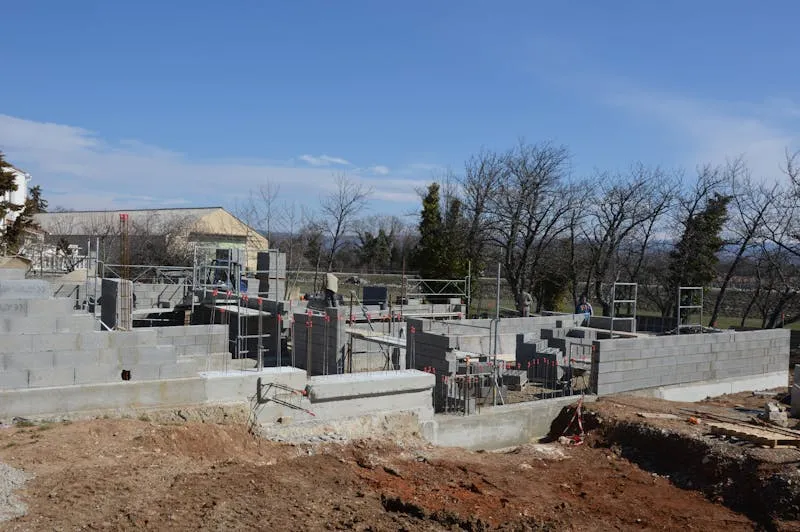
The formula is straightforward: wall area divided by the face area of one block. A standard UK concrete block measures 440mm × 215mm. Add 10mm mortar joints on each side and you get a coordinating face of 450mm × 225mm, which works out to 0.1013 square metres per block.
Divide 1 by 0.1013 and you get 9.88 blocks per square metre — rounded to 10 in practice. Multiply your wall area by 10 and add your waste percentage. A 6m × 1.8m garden wall has an area of 10.8m², needing 108 blocks before waste. At 5% waste, order 114 blocks.
If the wall has a door or window opening, subtract that area first. A standard door at 0.9m × 2.1m removes 1.89m² from the total. The block calculator above handles this with the opening deduction checkbox.
Mortar adds up too. For 100mm blockwork with 10mm joints, budget 0.012 cubic metres of mortar per square metre of wall. A 10.8m² wall needs 0.13m³ of mortar — around 39kg of cement and 194kg of sand in a 1:5 mix. The calculator works this out for all three block thicknesses.
Standard UK Concrete Block Sizes and Dimensions
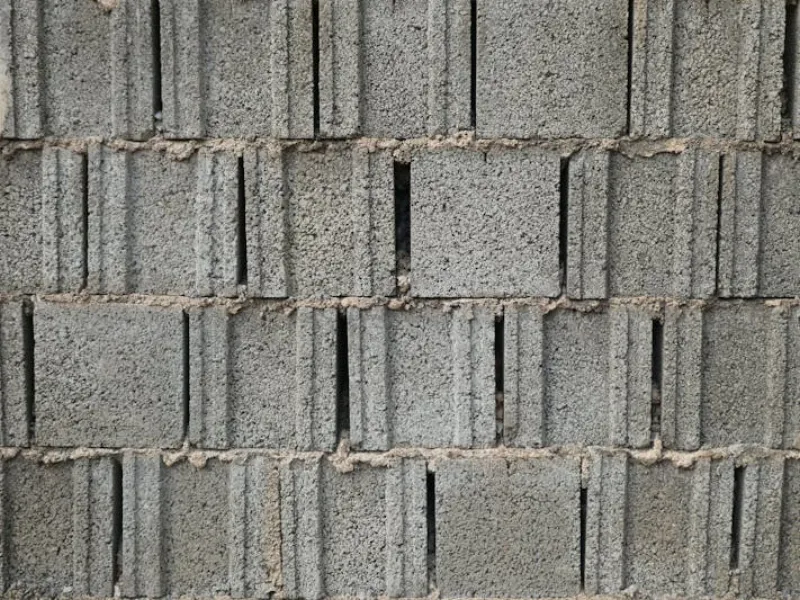
Every concrete block in the UK shares the same face dimensions: 440mm long × 215mm high. The difference is thickness. Three sizes cover almost all domestic and light commercial work.
| Type | Dimensions (L×H×W) | Weight | Blocks/m² | Typical Use |
|---|---|---|---|---|
| 100mm dense | 440×215×100mm | ~20kg | 10 | Inner leaf, partitions |
| 140mm dense | 440×215×140mm | ~28kg | 10 | Loadbearing walls |
| 215mm dense | 440×215×215mm | ~43kg | 10 | Single-skin, retaining |
| 100mm hollow | 440×215×100mm | ~15kg | 10 | Non-loadbearing partitions |
| 100mm aerated | 440×215×100mm | ~8kg | 10 | Inner leaf (thermal) |
All UK blocks conform to BS EN 771-3 and carry a compressive strength rating. Standard dense blocks achieve 7.3 N/mm², with high-strength options reaching 10.4 N/mm² for loadbearing applications. When ordering from builders merchants, specify the thickness and whether you need dense, hollow, or aerated blocks.
Blocks Per Square Metre: Coverage by Block Size
The coverage rate stays at 10 blocks per m² regardless of thickness. A 100mm wall, 140mm wall, and 215mm wall all use the same number of blocks per square metre because the face size does not change. The only difference is mortar volume — thicker blocks need more mortar in the perpend joints.
| Courses | Wall Height |
|---|---|
| 4 | 0.900m |
| 5 | 1.125m |
| 8 | 1.800m |
| 10 | 2.250m |
| 11 | 2.475m |
Each course adds 225mm: a 215mm block plus a 10mm bed joint. This coordinating height matches three courses of standard brickwork, which makes cavity wall construction straightforward. If you are building a brick-and-block cavity wall, one course of blocks lines up with every three courses of bricks.
For accurate ordering, round your wall height up to the nearest full course. A 2m wall needs 9 courses (2.025m), not 8.89. Use the concrete block calculator above to see the exact course count for your dimensions.
Concrete Block Types: Dense, Hollow and Thermalite
Dense aggregate blocks (brands like Lignacite and Forticrete) weigh 20kg each at 100mm thickness. They have high compressive strength and resist moisture, making them the standard choice for below-DPC work, retaining walls, and any external application. The weight is the main drawback — at 28kg per 140mm block, they test manual handling limits on a full day's laying.
Hollow blocks weigh around 15kg at 100mm. The voids reduce material without much loss of strength for non-loadbearing partitions. Some hollow blocks accept vertical rebar for reinforced retaining walls, with the cores filled with concrete after the wall is up.
Aerated blocks (Thermalite, Celcon) weigh just 8kg at 100mm and provide much better thermal insulation than dense blocks. They are the default choice for the inner leaf of cavity walls in new-build houses, helping meet Part L of the Building Regulations. Cut them with a hand saw rather than a disc cutter. Do not use aerated blocks below damp-proof course level or in ground-contact situations — they absorb water.
For a garden wall or boundary wall, use dense blocks throughout. For an extension or garage, use dense blocks for the outer leaf and foundation courses, and aerated blocks for the inner leaf above DPC. The concrete base calculator can help you work out the foundation concrete for your wall.
Tips for Ordering Concrete Blocks in the UK
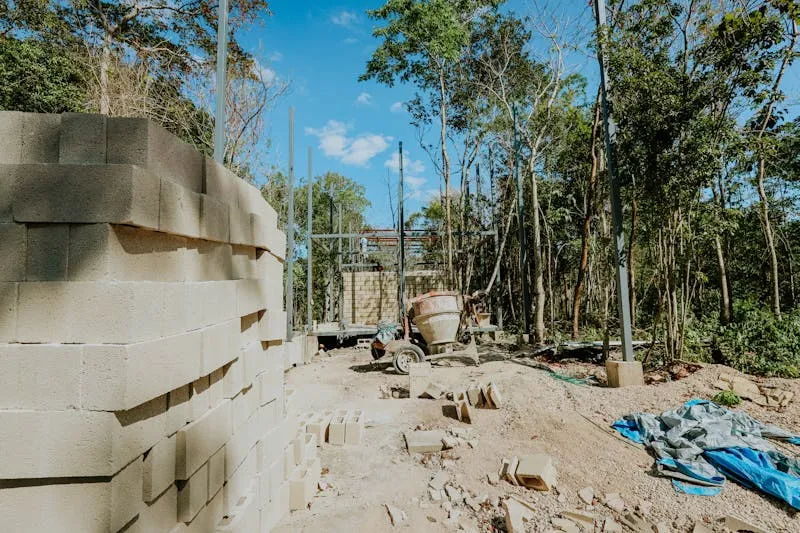
Buy from a builders merchant rather than a DIY chain. Jewson, Travis Perkins, and local independents sell blocks by the pallet at trade prices. A pallet holds 72 standard 100mm blocks and costs around £130-145. Loose blocks from B&Q or Wickes cost 30-50% more per unit.
Delivery is usually free on orders over one pallet. Check access before ordering — a lorry with a crane offload (hiab) needs 4m width and firm ground. If your site is tight, ask about a flatbed with manual offload or collect with a trailer.
Store blocks on level ground, raised on timber bearers to keep them dry. Cover the top of each pallet with a tarp but leave the sides open for air circulation. Blocks that absorb rain before laying will shrink as they dry out in the wall, opening up the mortar joints.
Order 5-10% extra. Cuts at corners and around openings waste partial blocks. Returns are rarely accepted on broken pallets, so surplus blocks are useful for future repairs or garden projects. Check our footing calculator to work out the concrete you need for the foundation strip before the blockwork starts.
Related Concrete Calculators
Concrete Block Calculator FAQ
You need approximately 10 standard concrete blocks per square metre. This uses the UK standard block size of 440×215mm with 10mm mortar joints, giving a coordinating face of 450×225mm.
The exact calculation is 1 ÷ (0.450 × 0.225) = 9.88, rounded to 10 in practice. Add 5% for cuts and breakages when ordering.
This rate applies regardless of block thickness — 100mm, 140mm, and 215mm walls all use 10 blocks per m².